A Practical Guide to Intimacy with Arthritis
Research-Backed, Non-Pill Solutions for a Fulfilling Sex Life
Over half of people with arthritis say joint pain affects their sex life, and the vast majority never raise it with their doctor. Here is what the research says, and the tools that help.
Key Takeaways
- 32.4% of people with rheumatoid arthritis experience sexual dysfunction, per a 2024 meta-analysis of 9,174 patients (Salari et al., Sexuality and Disability).
- 93.5% of women and 85.5% of men with RA had not raised sexual issues with a clinician in the previous 5 years (Bay et al., 2020, 329 patients).
- Having RA carries roughly a 10 times higher risk of sexual dysfunction than healthy controls (EULAR Congress, 2022).
- Hip joint involvement predicted sexual dysfunction more strongly than knee or hand involvement in a 2012 study (El Miedany et al.).
- Fatigue hurt sexual activity for 46.5% of RA patients, independent of pain levels.
- Moist heat for 15 to 20 minutes at 92 to 100°F before activity is the ACR-aligned warm-up.
- Late morning or early afternoon beats nighttime for most people with RA (ACR patient guidance, updated April 2025).
- A topical like Penetrex needs 30 to 60 minutes of skin contact before activity to absorb fully.
Medical disclaimer and disclosure
This guide is informational and educational only. It is not medical advice. If you have active joint inflammation, recent joint surgery, or significant changes in your condition, consult your rheumatologist or GP first. This page contains affiliate links, and JointLabPro may earn a commission on qualifying purchases at no extra cost to you. Full affiliate disclosure here.
The Conversation About Sex and Arthritis That Nobody Has
Back in 2007, Arthritis Today, the Arthritis Foundation’s flagship magazine, opened an article by pointing out that your sex life rarely gets any airtime at a rheumatology appointment, then argued that maybe it should.
Two decades later, surprisingly little has changed. A 2020 cross-sectional study in Sexual Medicine, run at Odense University Hospital in Denmark with 329 patients, found that 93.5% of women and 85.5% of men with rheumatoid arthritis had not discussed sexual issues with a healthcare professional in the previous five years.
The issue is neither rare nor unimportant. It just feels awkward to raise, for patients and clinicians alike. So millions of people who manage pain, stiffness, and fatigue everywhere else in their lives end up handling intimacy problems in silence.
This guide takes the opposite approach. The science is solid, the practical fixes exist, and most of the products that help cost less than a single specialist copay.
(Odense University Hospital, 2020)
(Hill et al., Rheumatology, 2003)
(EULAR Congress, 2022)
What the research actually shows
A 2024 systematic review and meta-analysis in Sexuality and Disability (Salari et al.) pooled 53 studies covering 9,174 patients with rheumatoid arthritis and found sexual dysfunction in 32.4% overall, rising to 36.5% in women and 23.5% in men. A separate 2022 study presented at EULAR found that RA carries a 10 times greater risk of sexual dysfunction compared to healthy controls from the same region. This is one of the most under-addressed quality-of-life issues in rheumatology.
Skip to the solutions
Jump to: Tool #1, the warm-up · Tool #2, the positioning system · Tool #3, the relief layer · the complete protocol table
Why Arthritis Affects Intimacy
Five distinct mechanisms operate at the same time, which is why single fixes usually fall short. Understanding them is the first step to solving them.
1. Joint pain and stiffness during weight-bearing
The most obvious barrier. OA most often hits the hips, knees, and lower back, and those are exactly the joints under the most mechanical load during intimacy. Hip joint involvement is documented as one of the strongest predictors of sexual dysfunction in RA patients (El Miedany et al., Clinical Rheumatology, 2012). Strategic positioning and joint support solve most of this, which is what Tool #2 below is for.
2. Morning stiffness and the timing mismatch
Culture links intimacy with nighttime. For most people with inflammatory arthritis, nighttime is the worst possible window: cortisol sits at its daily low, inflammatory activity peaks, and joint fluid is thickest after hours of inactivity. The American College of Rheumatology’s clinical guidance (updated April 2025) recommends timing intimate activity for whenever you feel best during the day, which for most people with RA means late morning or early to mid afternoon.
3. Fatigue as its own factor
Pain and stiffness get most of the attention, but the Danish study found that among patients with RA-related fatigue, 46.5% said it hurt their sexual activity, independent of pain levels. Inflammatory fatigue differs from ordinary tiredness. It is a systemic feature of the disease, and on some days it disables more than pain does. Pacing, rest before activity, and heat preparation all address this piece.
4. Body image and the psychological side
Chronic pain changes how we experience our bodies. Research in Clinical Experimental Rheumatology found that women with RA reported significantly altered body image, and patients with poor quality of life had a 3.5 times higher risk of sexual dysfunction than patients with good quality of life (MDPI, 2022). Reduced mobility, joint changes, and dependency can all affect self-perception in intimate contexts.
5. The communication silence
Perhaps the most important factor, and the easiest to fix. Studies consistently show that partners of people with arthritis often misjudge the physical constraints, which leads to misread cues, avoided intimacy, and relationship strain. The primary intervention here is simple and free: an early, direct conversation, ideally outside of intimate moments, about what works and what has changed.
When to speak to your doctor first
If you have active inflammation (warm, swollen joints), a recent flare, recent joint surgery, or a significant change in symptoms, consult your rheumatologist before using heat therapy or changing positions significantly. Some joint conditions require specific positional restrictions. Medications for RA, particularly methotrexate, sulfasalazine, and hydroxychloroquine, have in some cases been associated with erectile dysfunction, which is worth raising with your prescriber if relevant.
Plan Intimacy Around Your Best Arthritis Window
This is the highest-impact, zero-cost step in the entire guide. The ACR’s patient guidance on sex and arthritis (updated April 2025, reviewed by rheumatologist Dr. Pankti Reid, MD, MPH) leads with it: plan intimacy for the part of the day when you feel your best.
For most people with OA or RA, that means:
- Late morning, 10am to noon. Morning stiffness has resolved and medications have kicked in, but afternoon fatigue has not arrived yet.
- Early afternoon, 1pm to 3pm. Often the best window for RA specifically. Joint fluid has circulated through a morning of movement and the day’s fatigue has not peaked.
- After a rest period. On higher-fatigue days, the ACR recommends napping or resting beforehand.
- After a heat warm-up. Covered in Tool #1 below.
About medication timing
If short-acting NSAIDs like ibuprofen are part of your as-needed pain plan, the ACR suggests timing them so peak effect lands during planned intimacy, typically 30 to 60 minutes before. This applies to as-needed use only, and your doctor’s specific guidance on your medication always comes first.
A Moist Heat Warm-Up Before Intimacy
The Arthritis Foundation describes heat therapy as “one of the oldest, cheapest, and safest forms of complementary therapy” for arthritis, and there is solid science behind why it works before physical activity, intimacy included. The ACR and the Arthritis Foundation jointly and conditionally recommend heat therapy for OA of the knee, hip, and hand (ACR/Arthritis Foundation OA Guidelines, Arthritis Care & Research, 2020).
The mechanism: heat dilates blood vessels around an arthritic joint, so blood flow and oxygen delivery go up. Muscle spasms ease. Joint fluid warms, thins out, and moves better, and the synovial membrane becomes more pliable. Range of motion improves and pain thresholds rise. That is exactly the state you want a joint in before it takes load.
How long and how hot?
The Arthritis Foundation recommends at least 15 minutes of moist heat before activity, and 20 minutes is the sweet spot. Temperature should be warm rather than hot. The recommended range for warm baths and showers is 92 to 100°F (33 to 38°C), and an electric heating pad with a moist heat setting reaches that range reliably without the skin irritation that dry heat causes at higher temperatures. One caution: never apply heat to an acutely inflamed, warm, or swollen joint. Active flares get cold, not heat.
For intimacy specifically, a 15 to 20 minute heating pad session does two things at once. It loosens the joints that will be under load, and it creates a deliberate preparation ritual that lowers anxiety about pain, which matters for the psychological side of intimacy with chronic pain.
The GENIANI covers hip, lower back, knee, and shoulder, the four areas most often behind arthritis-related intimacy trouble. The moist heat setting penetrates deeper than dry heat, which is what stiff joints respond to. Six temperature levels let you find your range, and at 12 by 24 inches it covers a full hip or the whole lower back in one go.
The warm bath alternative
A warm bath, about 20 minutes at 92 to 100°F, remains the most complete heat delivery method for arthritis preparation: full-body joint mobilization, muscle relaxation, and mental decompression in one. The ACR includes warm baths in its recommendations. When a bath 20 or 30 minutes ahead is practical, take the bath. The heating pad is the everyday option for when it is not.
Apply heat to your most problematic joints, typically hip, lower back, or knee, for 15 to 20 minutes. Do it before you need it, not once you are already in discomfort.
Pillow Support for Arthritic Joints During Intimacy
The single most consistent recommendation across every credible source on arthritis and intimacy, from the ACR to WebMD to CareScout’s medical team, is to use pillows to support your joints. This is the primary mechanical intervention, and the difference between a well-placed support pillow and nothing can be the difference between a comfortable experience and a flare.
The biomechanics are straightforward. Arthritic joints tolerate load poorly when unsupported or rotated, and a joint in neutral alignment bears far more force than one that is torqued or compressed. Two pillow types address the two most common positional problems.
The Wedge Pillow for Hip and Lower Back Support
A wedge pillow placed under the lower back, hips, or beneath the receiving partner creates a stable, raised platform that keeps the pelvis and lumbar spine supported and neutral. This is the most versatile joint support tool for arthritis-related intimacy. It works for hip OA, lumbar OA, sacroiliac involvement, and knee OA too, since it reduces the angle of hip flexion required.
CareScout’s clinical guidance suggests keeping a wedge pillow in the bed permanently, so nothing has to be fetched or set up if a moment starts on its own. That small tip does real work, because chronic pain management and spontaneity rarely coexist unless you remove the setup friction in advance.
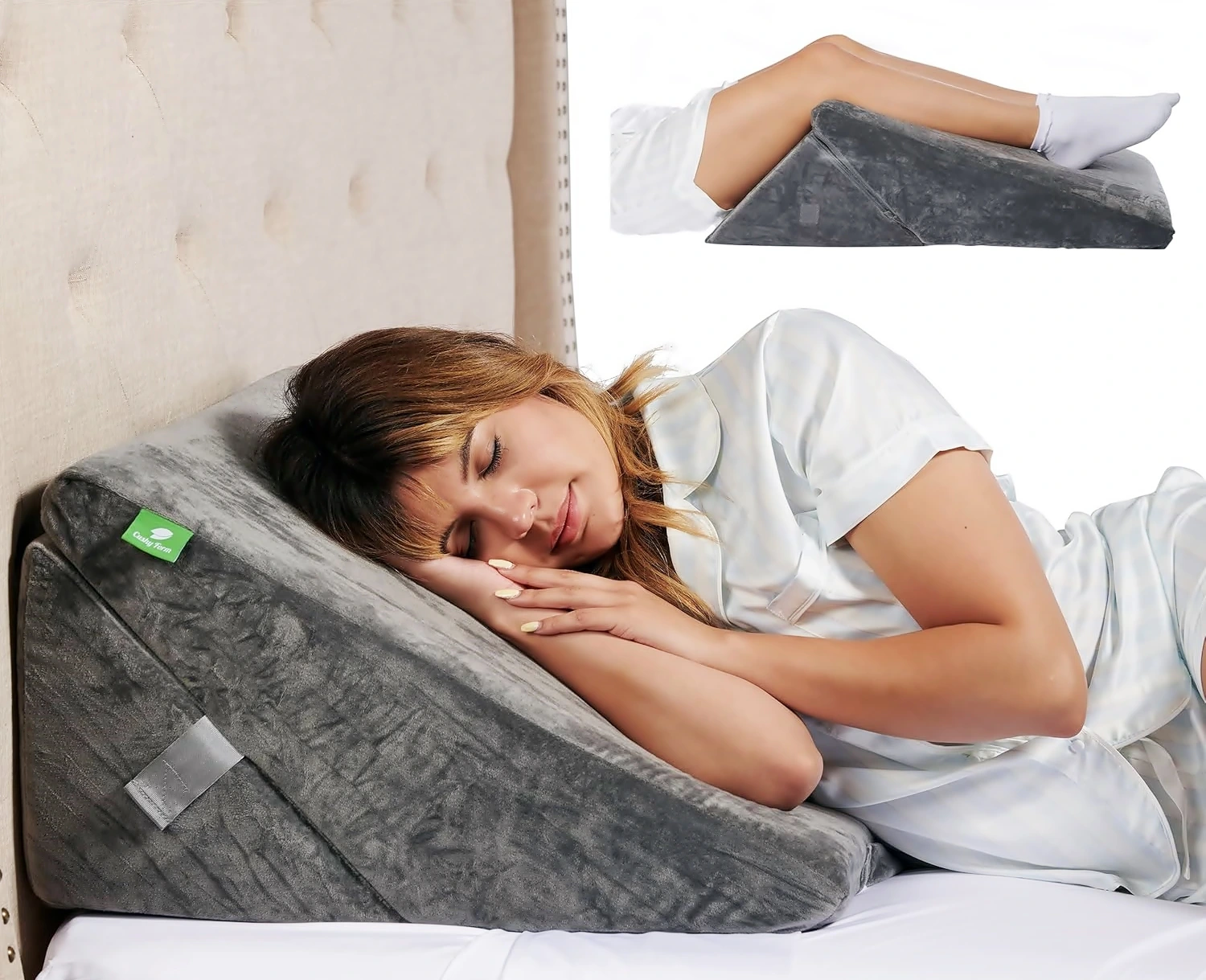
The foam is dense enough to hold its shape under body weight, where a standard pillow compresses flat within minutes. It can sit under the lower back and hips when lying on your back, under the torso when lying face down, or vertically as back support while sitting. And because it doubles as a reading and sleep pillow, it can live on the bed permanently without looking clinical, which is exactly what the CareScout guidance recommends for spontaneity.
The Knee Pillow for Side-Lying Positions
For side-lying intimate positions, which WebMD, the ACR, and multiple physical therapy sources rank among the most joint-friendly, a knee pillow between the legs stops the top leg from dropping forward and rotating the hip joint.
When the hip rotates under load without support, it compresses the lateral structures of the knee and stresses the hip capsule at the same time. That combination is the mechanical source of much of the knee and hip pain people with OA feel afterward.
The adjustable strap is the detail that matters. It keeps the pillow between the knees during movement instead of falling away within minutes, which is where regular pillows fail. The cooling gel layer prevents the overheating common with solid foam. It works for knee OA, hip OA, and lower back pain at once by holding the hips in neutral alignment, and it is one of the best-value joint support tools you can buy.
Position adaptations the clinical literature recommends
The ACR, WebMD, and arthritis physical therapy sources consistently point to these joint-friendly positions for people with hip, knee, and back OA or RA:
- Side-lying (spooning): partner with arthritis in front, knee pillow between knees. Removes all weight-bearing from hip and knee joints. Recommended for hip OA, knee OA, and lower back involvement.
- Receiving partner on their back with a wedge under hips and lower back: reduces the hip flexion range required and removes lumbar pressure. Particularly good for lower back and hip OA.
- Sitting positions: chair height removes floor-level pressure on the knees entirely. Suitable for severe knee involvement.
- Partner with arthritis on top, supported on hands and knees: allows control of weight distribution. Less suitable for wrist or hand OA.
Keep both pillows on the bed as permanent fixtures rather than in a closet. Accessibility matters when spontaneity is part of the goal.
A Topical Anti-Inflammatory Layer with Penetrex
The heat warm-up and the positioning system handle stiffness and mechanical load. The topical layer handles residual inflammation at the tissue level, the deep ache that persists even after a joint is warm and well-positioned.
Topicals have a specific advantage over oral analgesics for this purpose: they work locally, with no systemic side effects at normal use. They also skip the whole question of whether to take an oral med before intimacy, which many people would rather avoid. The ACR’s intimacy guidance mentions topical analgesics as a preparation tool alongside heat therapy.
How Penetrex works, and why it differs from a numbing cream
Penetrex uses Arnica Montana, a traditional anti-inflammatory herb with some clinical trial support for joint pain, and Boswellia, an Ayurvedic resin with evidence for lowering inflammatory markers in OA. Menthol products like Biofreeze and Voltaren work through a strong cooling sensation. Penetrex takes a slower route, acting on inflammation at the tissue level over 30 to 60 minutes of skin contact, with no cooling or numbing feeling at all. That slower action makes it a better fit for pre-activity application than for instant relief. Apply it 30 to 60 minutes ahead so it absorbs.
The practical sequence: Penetrex 45 to 60 minutes before, then the heating pad for the final 15 to 20 minutes. The topical acts at the tissue level while the heat raises local blood flow and absorption. Both push in the same direction, reducing the inflammatory ache that loads arthritic joints in any weight-bearing context.
Penetrex has three practical advantages for pre-intimacy use. It is non-greasy and absorbs fully within a few minutes. The scent is subtle and inoffensive, where mentholated products announce themselves. And it produces no cold or burning sensation that would make skin contact less pleasant. Apply to the knee, hip crease, lower back, or any joint that typically complains, covering the full joint circumference rather than just the most painful point.
Penetrex vs Biofreeze for this specific use case
Biofreeze, a menthol product, excels at acute pain management and sleep preparation, since its fast-acting Gate Control mechanism turns down pain signals quickly. For pre-intimacy preparation, Penetrex generally fits better. It works slowly on inflammation without the strong cooling sensation, and the absence of a menthol smell suits the context. For soreness afterward, Biofreeze is the better pick. See our full Penetrex vs Biofreeze vs Voltaren comparison.
Open Communication Does More Than Any Tool
The literature on arthritis and intimacy is unusually consistent on one point. A review in Nursing Clinics of North America (2007) put it memorably: the three most important things for a successful sexual relationship with arthritis are “communication, communication, communication.”
That line reflects a genuine evidence base, and communication carries more weight in arthritis than in many other chronic conditions for a few reasons:
- Pain is invisible and it varies. A partner cannot see a flare, so skipped intimacy on a bad day gets misread as lost desire, and the resulting strain compounds the original problem.
- Needs change week to week. What worked last week may not work this week, and a good day after a bad stretch means resetting expectations, which requires talking.
- The position changes that protect arthritic joints need active coordination from both people, which only happens through explicit, comfortable discussion.
A practical approach to the conversation
CareScout’s medical team recommends what they call “vertical, not horizontal, conversations.” Talk about this over morning coffee, not in the bedroom mid-moment. The goal is shared language (“today is a 6 out of 10 hip day”), a shared picture of what joint-friendly means for your specific situation, and mutual permission to pause or adjust without it reading as rejection. And it is never a one-time talk. The dialogue evolves as the condition does.
If starting these conversations feels hard, a session or two with a therapist experienced in chronic illness can genuinely help. Your rheumatology team may be able to refer you, or point you to the Arthritis Foundation’s resources on relationships and chronic pain.
The Complete Pre-Intimacy Protocol for Arthritis
| Timing | Action | Tool | Purpose |
|---|---|---|---|
| Plan timing | Choose late morning or early afternoon, your best daily window | None | Avoid morning stiffness and nighttime fatigue |
| 60 min before | Apply Penetrex to affected joints (hip, knee, lower back) | Penetrex | Arnica and Boswellia reduce tissue-level inflammation |
| 20 to 40 min before | Optional: warm bath, 20 min at 92 to 100°F, for full-body joint preparation | Bath | Most complete joint warm-up (ACR recommended) |
| 15 to 20 min before | Apply GENIANI heating pad to the most symptomatic joints | GENIANI Heating Pad | Loosens stiffness, raises blood flow, eases muscle spasm |
| Always present | Wedge pillow under hips and lower back for supine positions | Cushy Form Wedge | Neutral pelvis, less hip and lumbar load |
| Always present | Knee pillow between knees for side-lying positions | Everlasting Comfort Knee Pillow | Hip alignment, prevents condylar compression |
| After activity | Cold pack on any joint that feels warm or inflamed (not merely stiff) | Ice pack / gel pack | Calms post-activity inflammation if a joint reacts |
The core principle
Nothing above is difficult or expensive, and nothing involves taking an oral medication specifically for intimacy. Prepare the joints before activity with heat and a topical. Support them during activity with positioning. Manage any reaction after with cold, if a joint feels warm. This maps one to one onto what physical therapists recommend for any joint-loading activity.
The mindset shift that matters most: treat intimacy with arthritis the way you would treat exercise with arthritis, with preparation and pacing, and it stops being something to avoid.
Frequently Asked Questions About Intimacy with Arthritis
During an active flare, particularly if a joint is warm, visibly swollen, and clearly more painful than baseline, the general guidance is to rest the involved joint and let the inflammation settle. Loading an actively inflamed joint can prolong a flare. That said, not every bad day is a medical flare, and there is a spectrum. Non-weight-bearing forms of intimacy, like massage, physical closeness, or positions that remove all load from the affected joint, may still be fine. Listen to your body and consult your rheumatologist if you are unsure about your own boundaries.
Research (El Miedany et al., 2012) found hip joint involvement to be one of the strongest predictors of sexual dysfunction in RA patients, notably more than knee or hand involvement. Lower back and lumbar OA rank close behind, because the lumbar spine is involved in nearly every position. Knee OA comes third. Hand and wrist involvement matters mainly for positions that bear weight on the hands, and seated or supported positions remove that problem entirely.
Penetrex is intended for joint and muscle areas only: hips, lower back, knees. Applied 30 to 60 minutes before activity, it is fully absorbed by the time intimacy begins. It is never applied to mucous membranes or sensitive skin. Menthol products like Biofreeze and Voltaren call for even more caution given the strong cooling sensation they produce. Apply topicals well in advance and to non-sensitive joint areas only, and if you notice any skin reaction, stop and check with your pharmacist or physician.
The American College of Rheumatology notes that arthritis medications generally do not appear to affect sexual functioning, though some cases of erectile dysfunction have been reported in patients treated with methotrexate, sulfasalazine, or hydroxychloroquine. If you notice changes in sexual function that coincide with a medication change, raise it with your prescriber. This is a recognized, documented area, and your rheumatologist will not be surprised by the question.
Yes, and it is underused. A physiotherapist experienced in arthritis can assess your specific joint limitations, suggest individualized position modifications, and work on range of motion in the joints that matter most for you. WebMD notes that range-of-motion work with a physical therapist often improves both self-esteem and pain in people with RA, and those gains carry over to intimate life. You do not need to frame the session around intimacy at all. Any work on hip and lumbar mobility applies directly.
Yes, and the research suggests most patients never do. The 2020 Danish study found that over 90% of women and 85% of men with RA had not discussed sexual issues with a healthcare professional in the previous five years. Your rheumatologist will not be uncomfortable. Intimacy and quality of life sit squarely within the scope of rheumatology care, and the ACR’s official patient guidance on this topic was updated as recently as April 2025. A simple opener works: “My joint pain has been affecting my intimate life. Can we talk about my options?”
I manage early OA in both knees, and I will be honest, this is the topic I was most reluctant to write about. It also turned out to be the one I now think matters most. The silence around arthritis and intimacy exists because nobody wants to go first.
The research is clear, though. This affects a large share of people with moderate to severe arthritis, and the fixes are practical, affordable, and they work. The GENIANI heating pad has lived on my bedside table for over a year. It gets used before exercise, before long walks, and before anything else physical that matters to me. The wedge pillow stays on the bed. Penetrex goes on about an hour ahead.
I think of all of it as preparation, the same way I warm up before a workout. That mindset is what lets you keep showing up for the parts of life that make it worth living.
Sarah Mitchell, JointLabPro
Keep Reading
If heat preparation helped, compare moist heat options side by side in the best heating pad for joint pain review.
Unsure which topical suits which situation? The Penetrex vs Biofreeze vs Voltaren comparison covers when each one earns its spot.
If your pain peaks at night rather than during the day, start with the nighttime joint pain and sleep guide.
The timing advice here pairs naturally with the morning knee stiffness routine.
Neck pain shaping how you sleep and position? See the best pillow for neck and joint pain review.
For the longer-term side of pain management, the best joint supplements guide covers what the evidence supports.
Sources & References
1. Bay LT et al. “Sexual Health and Dysfunction in Patients With Rheumatoid Arthritis: A Cross-sectional Single-Center Study.” Sexual Medicine 2020;8:615-630. Odense University Hospital, Denmark.
2. Salari N et al. “The Global Prevalence of Sexual Disorder in Patients with Rheumatoid Arthritis: A Systematic Review and Meta-Analysis.” Sexuality and Disability 2024;42:535-551.
3. Hill J, Bird H, Thorpe R. “Effects of rheumatoid arthritis on sexual activity and relationships.” Rheumatology 2003;42:280-286.
4. Valera-Ribera C et al. “Impact of chronic joint diseases on the sexual sphere: a multicenter study.” EULAR Annual European Congress of Rheumatology 2022.
5. El Miedany Y et al. “Sexual dysfunction in rheumatoid arthritis patients: arthritis and beyond.” Clinical Rheumatology 2012;31:601-606.
6. American College of Rheumatology. “Sex & Arthritis.” Reviewed by Pankti Reid MD, MPH. Updated April 2025. rheumatology.org
7. Kolasinski SL et al. “2019 ACR/Arthritis Foundation Guideline for the Management of Osteoarthritis of the Hand, Hip, and Knee.” Arthritis Care & Research 2020;72(2):149-162.
8. Arthritis Foundation. “Heat Therapy Helps Relax Stiff Joints.” arthritis.org
9. Cleveland Clinic / Mass General Brigham. Heat therapy for arthritis, clinical guidance.
10. MDPI. “Sexual Dysfunction and Quality of Life in Patients with Rheumatoid Arthritis.” International Journal of Environmental Research and Public Health 2022;19(5):3088.
* This article is for informational and educational purposes only and does not constitute medical advice. Always consult a qualified healthcare provider for persistent or worsening joint pain. Sources referenced include peer-reviewed publications, American College of Rheumatology guidelines, and Arthritis Foundation resources. Some links are affiliate links. JointLabPro participates in the Amazon Associates affiliate program and may earn commissions on qualifying purchases at no extra cost to you. Individual results vary.