The Best Recovery Tools for Joint Pain in 2026
A former PE teacher managing OA in both knees on the three recovery tools that actually reduce stiffness and support joint health: a foam roller, a massage gun, and resistance bands, plus how to use each without triggering a flare.
Key Takeaways
- Resistance bands are the highest-leverage tool: a 2022 meta-analysis of 46,819 people found low knee-extensor strength raises the risk of developing knee OA (Oiestad et al., Br J Sports Med).
- Foam rollers and massage guns work on the muscles around a joint, never on the joint itself, so they relieve tension without loading cartilage.
- The TheraGun Relief runs a 10mm stroke versus 16mm on athlete models, which is why it suits sensitised joints rather than deep tissue.
- All three tools should be paused during an active flare, when a joint is warm and swollen, and restarted at the lightest level once it settles.
- Strength gains start in about 2 to 4 weeks, but meaningful pain reduction from stronger muscles usually takes 6 to 12 weeks.
- Combined Amazon ratings sit at 4.5 to 4.7 stars across roughly 160,000 reviews for the three picks.
- A 20-minute daily routine runs foam roller first, bands second, massage gun last, ideally in late morning.
Affiliate disclosure
This article contains affiliate links. If you buy through them, JointLabPro may earn a small commission at no extra cost to you. Full affiliate disclosure here.
When I was still teaching PE, I used recovery tools every week. Foam rollers before class, resistance bands for rehab drills, a massage gun after long days on my feet. I knew how to use them. What I did not know was what it would feel like to use them with OA in both knees.
The rules change once a joint is arthritic. Some tools that work brilliantly on healthy joints can aggravate a sore one, because too much pressure at the wrong moment, or too much load on an inflamed joint, leaves you worse off than before you started.
This guide covers the three recovery tools I now treat as non-negotiable for joint pain: a foam roller, a massage gun, and resistance bands. For each one I picked the specific product that suits people with joint conditions rather than athletes, and spelled out how to use it without setting off a flare.
Quick navigation
Budget pick: Fit Simplify Resistance Bands
Top pick: TriggerPoint GRID Foam Roller
Premium pick: TheraGun Relief Massage Gun
Why Recovery Tools Matter for Joint Pain
Most joint pain advice focuses on what goes into your body: supplements, medications, anti-inflammatory food. Recovery tools work on a different level. They address the mechanical and muscular contributors to pain that no pill reaches.
With OA and RA, three things reliably make daily pain worse.
The three mechanical problems recovery tools solve
Muscle tension around the joint. When a joint hurts, the surrounding muscles tighten to protect it. That tension adds compression to the cartilage and makes pain worse. Foam rollers and massage guns release it without loading the joint directly.
Muscle weakness around the joint. Pain makes people move less, which weakens the muscles that stabilize the joint, and that instability feeds back into more pain and more avoidance. Resistance bands are the safest way to rebuild that strength without impact. This is not a small effect: in a 2022 meta-analysis of 46,819 men and women, low knee-extensor strength was linked to a higher risk of developing knee OA (Oiestad et al., British Journal of Sports Medicine).
Poor circulation and fluid stagnation. Movement circulates synovial fluid, which feeds cartilage. Sitting still lets that fluid thicken and stagnate, which is a big part of morning stiffness. All three tools help restore circulation to the joint area.
The American College of Rheumatology lists regular low-impact exercise among the most evidence-backed interventions for knee OA. Recovery tools make that exercise sustainable by cutting preparation time, improving mobility, and speeding recovery between sessions.
Budget Pick: Fit Simplify Resistance Loop Bands
Budget pick, best value for joint strengthening
Fit Simplify Resistance Loop Exercise Bands, Set of 5
Five resistance levels from extra light to extra heavy. Latex. Carry bag and instruction guide included.
These are the most cost-effective joint health buy on this list, and also the most important. Muscle strength around the knee and hip is a primary factor in how OA symptoms progress, and the resistance band is the safest place to start building it. Every bit of quadriceps strength you add takes load off the joint with each step you take.
Bands have one advantage over free weights that matters for arthritic joints. The resistance builds gradually through the range of motion rather than staying constant, so the joint is never fully loaded at its most vulnerable angle. Physical therapists have leaned on TheraBand-style loop bands for decades for exactly that reason.
Critical note for joint pain users
Start with the yellow (extra light) band even if it feels too easy. With joint pain, the connective tissue and joint structures need time to adapt even when the muscle feels ready for more. Move up a level only after two weeks with no post-exercise flare.
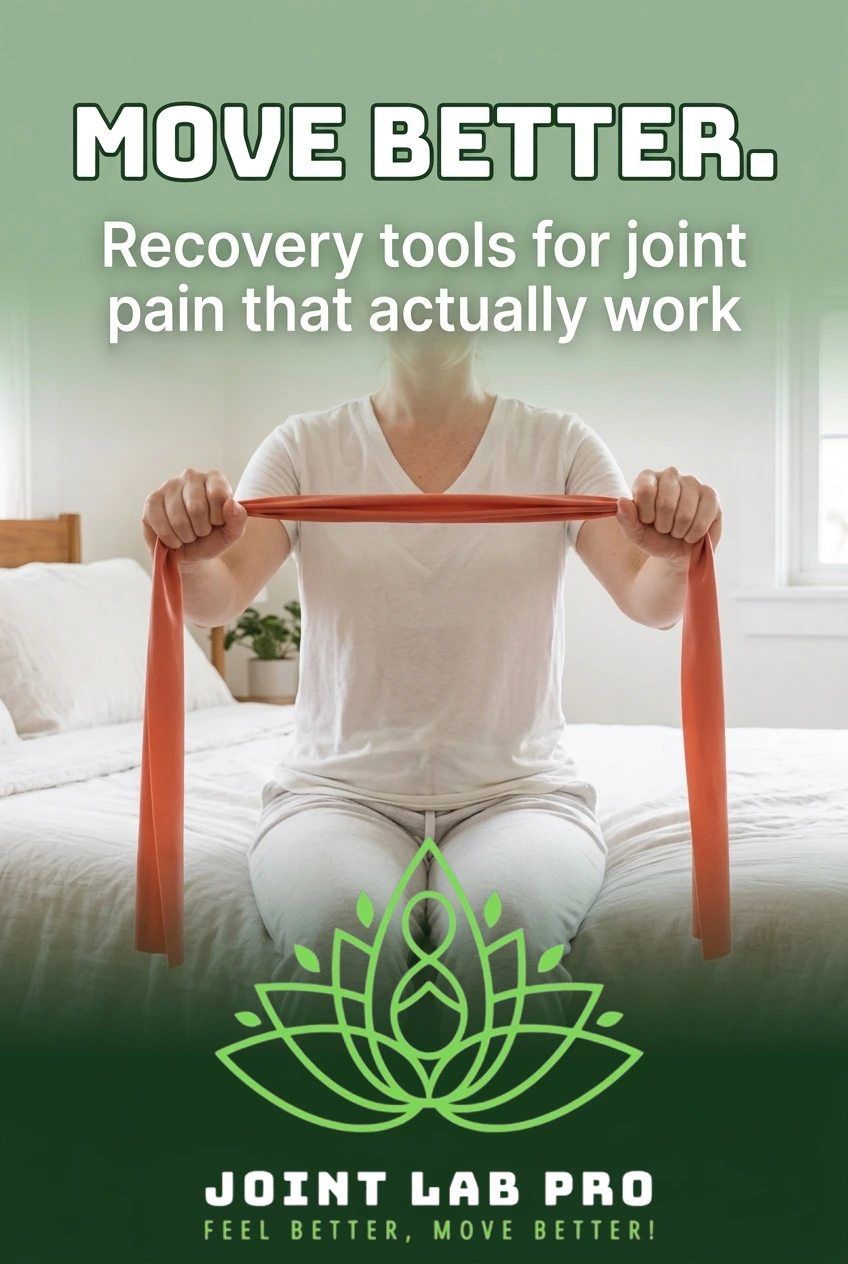
Best band exercises for joint pain: clamshells for the hip abductors, straight leg raises, seated knee extensions, glute bridges, and lateral band walks. Each targets the muscles that support the knee and hip without loading the joint with bodyweight.
Getting started with resistance bands, official Fit Simplify guide
Pros
- Lowest-cost full set of 5 levels on the list
- #1 bestseller in resistance bands
- 134,993 Amazon reviews behind it
- Instruction guide included, no guesswork
- Carry bag, usable anywhere, even seated
- Gradual resistance, joint-safe by design
Cons
- Latex, not suitable with a latex allergy
- Can roll up on the thigh during leg work
- No handles, harder to grip with hand arthritis
- Light bands wear faster with daily use
Best for
- Anyone with OA following the ACR exercise guidance
- Post-flare return to movement
- Beginners with no equipment yet
- Seated or floor-based routines
- Budget-conscious buyers wanting maximum value
Not ideal for
- Latex allergies (choose a non-latex TheraBand instead)
- An active RA flare, wait until it settles
- Anyone needing handles for grip support
Top Pick: TriggerPoint GRID 1.0 Foam Roller
Top pick, most recommended by physiotherapists
TriggerPoint GRID 1.0 Foam Roller, 13 inch
Multi-density surface. EVA foam. Firm. 5.75 by 13 inches. One-year manufacturer warranty.
The GRID is the foam roller physical therapists reach for most, and there is a reason. Its multi-density surface mimics the feel of a hand massage by alternating firmer and softer zones across the grid pattern. A plain foam roller applies uniform pressure; the GRID works the trigger points in the muscle more precisely.
For joint pain, the key thing is what a foam roller does and does not do. It works on the muscles around a joint, never on the joint itself. You never roll directly over an inflamed or bony joint. What you are doing is releasing tension in the quadriceps, hamstrings, IT band, and calves, all of which change how much load and compression the knee takes during movement.
The right way to use a foam roller with joint pain
Roll the muscle, never the joint. For knees, roll the quads at the front of the thigh, the hamstrings at the back, and the calves, but stop well above and below the kneecap. For hips, roll the glutes and outer hip. Spend 60 to 90 seconds per muscle group, and pause on a tender spot until the sensation eases before moving on.
Best timing: before activity to prime the muscles and blood flow, or after to reduce soreness. Skip foam rolling during an active flare, when the joint tissue is already inflamed.
The 13-inch length suits most people, long enough for full leg muscles but compact enough for a small room. The EVA construction holds its shape over years, where cheaper rollers compress flat and lose effect within months.
TriggerPoint GRID 1.0, official introduction and how to use
Pros
- Most recommended by physios for joint conditions
- 4.7 stars across 23,500+ reviews
- Multi-density surface mimics hands-on massage
- EVA foam holds shape for years
- Compact 13-inch length for home use
- Amazon’s Choice, well stocked and priced
Cons
- Firm texture, intense for first-timers
- Getting to floor level is hard for some OA patients
- No vibration, for deeper release look at vibrating models
- Costs more than a basic roller, but lasts far longer
Best for
- OA patients managing quad and hip flexor tightness
- Anyone doing band or light exercise, for pre and post rolling
- Those wanting a durable, physio-grade tool
- People with IT band tension feeding knee pain
Not ideal for
- Anyone who cannot get to floor level safely
- Active inflammatory flares, wait until settled
- Use on joints, it goes on surrounding muscle only
Premium Pick: TheraGun Relief by Therabody
Premium pick, built for everyday pain relief
TheraGun Relief Handheld Percussion Massage Gun
FDA-registered. 10mm amplitude. 3 speeds. Triangular grip. 3 attachments. Therabody app routines.
Most massage guns are built for athletes recovering from hard training. The TheraGun Relief is the exception. Therabody designed it as its gentlest model, for everyday relief in people who are not competitive athletes, which is what makes it the one massage gun I would recommend to someone with joint pain.
The difference comes down to amplitude: 10mm here against the 16mm on Therabody’s athlete-oriented models. That shorter stroke works on the superficial muscle tissue without the jarring percussion that can aggravate a sensitive joint area. It stays comfortable on tight quads and glutes in a way the deeper guns do not.
Why amplitude matters for joint pain
Amplitude is how far the head travels with each stroke. Higher amplitude means deeper penetration, which suits dense, healthy muscle in athletes. Around arthritic joints the muscle is often in protective spasm and already sensitised, so a shorter 10mm stroke delivers the circulation and tension relief without over-stimulating irritated tissue.
The triangular handle is a smart ergonomic choice. Standard massage gun handles force awkward wrist angles to reach some muscle groups, which matters if you also have hand, wrist, or shoulder arthritis. The triangle lets you hold the device from several angles without straining your grip.
The Therabody app adds guided routines for arthritis, sciatica, and general chronic pain. Each one shows where to place the device, at what speed, and for how long, which removes the guesswork that leads to using it wrong.
TheraGun Relief, official product tour by Therabody
Pros
- FDA-registered, not just a fitness gadget
- 10mm amplitude, gentle on sensitised joints
- Triangular handle, arthritis-friendly grip
- App with arthritis-specific routines
- 4K+ purchases last month
- Simple one-button control
- Quiet motor, usable without disrupting others
Cons
- Premium price for a gentle-use device
- Lower amplitude limits deep tissue reach
- Three speeds, fewer than athlete models
- Not water resistant, no post-shower use
Best for
- People with OA managing daily muscle tension
- Those who cannot get to the floor for foam rolling
- Anyone with hand or wrist issues needing an easy grip
- People who want guided, app-based instruction
- Anyone wanting an FDA-registered, clinically designed tool
Not ideal for
- Budget buyers, the bands give better value first
- Active RA flares with significant swelling
- Use over bony joints, muscle only
Recovery Tools Compared Side by Side
| Feature | Fit Simplify Bands | TriggerPoint GRID | TheraGun Relief |
|---|---|---|---|
| Price tier | Budget | Mid-range | Premium |
| Primary benefit | Strengthening | Muscle tension relief | Targeted muscle relief |
| Floor level required | Not always | Yes | No |
| Suitable for OA | Yes | Yes | Yes |
| FDA registered | No | No | Yes |
| Best timing | Anytime | Pre / post activity | Pre / post activity |
| Amazon rating | 4.5 ★ | 4.7 ★ | 4.6 ★ |
| Review count | 134,993 | 23,509 | 2,383 |
Sarah’s take on sequencing
Choosing just one? Start with the resistance bands. Strengthening the muscles around the joint has the biggest long-term impact on pain and function.
If budget allows, add the foam roller next, used before your band work to warm the muscles and open up range of motion.
The massage gun earns its place as a standalone tool for when floor exercises are off the table, on high-pain days, or for hitting one tight area fast without a full routine.
A 20-Minute Daily Joint Recovery Routine
As a former PE teacher, the thing I stress most is sequence. The order you use these tools in matters as much as the tools.
The 20-minute routine
Foam rolling, 5 minutes. Roll the major muscle groups around your most affected joints: quads, hamstrings, glutes, calves. About 60 seconds each. This loosens the tissue and lifts circulation before those muscles work.
Resistance bands, 12 minutes. Three or four exercises for the muscles that support your joints: clamshells, glute bridges, straight leg raises. Two or three sets of 12 to 15 reps. This is the strength work that shifts your baseline pain over time.
Massage gun, 3 minutes. Hit whatever feels tight after the exercises, about 60 seconds per area. This helps flush the muscular byproducts of exercise and cuts next-day soreness.
Best time of day: late morning, after morning stiffness eases but before afternoon fatigue builds, when joint fluid viscosity is at its friendliest.
You do not need all three every day. The bands are the priority, so aim for three or four days a week. Foam rolling can be daily. The massage gun is most useful on high-tension days, or when a full routine is not happening but you need relief.
Combining Recovery Tools with Other Joint Pain Management
Recovery tools plus a heating pad
Fifteen to 20 minutes of moist heat on the joint before your routine improves both the foam rolling and the band work. The heat loosens joint fluid and relaxes the surrounding muscle, so the exercises feel easier and land better. The ACR’s OA guidelines include heat among recommended interventions. See our best heating pad for joint pain review for options.
Recovery tools plus joint supplements
Glucosamine and chondroitin work at the cartilage level while recovery tools work at the muscular level, so they complement rather than repeat each other. If you take collagen peptides, the amino acids support the connective tissue you are loading and recovering in your routine. Our best joint supplements guide covers what the evidence supports.
When not to use recovery tools
During an active inflammatory flare, when a joint is warm, swollen, and acutely painful, rest beats recovery tools. The foam roller and massage gun stay on the muscle around the joint, never on the inflamed joint itself. Pause the bands during a severe flare and restart at the lightest level once it settles.
Sarah’s Verdict
The Recovery Tools That Changed How I Manage Joint Pain
I spent years as a PE teacher telling students that recovery matters as much as the workout. Living with OA in both knees has made that lesson a lot more personal than I expected.
The bands are the foundation. I use the yellow and red Fit Simplify bands three times a week for clamshells and glute bridges. The gain in knee stability over about six months of steady work did more for me than anything else I have tried.
The TriggerPoint GRID is what I reach for before any activity, even just walking to the shops on a bad day. Five minutes on the quads and outer hip, and my knees move better for the next hour. The multi-density surface makes a real difference over a plain roller.
The TheraGun Relief earns its spot on high-pain days when I cannot get down to the floor to roll. Standing, reaching my outer thigh or lower back, two minutes and the tension lets go in a way that changes how the joint feels straight away.
None of these replaces medication or medical care. Together, though, they gave me a physical toolkit for the days I need to function despite pain, which for most of us with OA or RA is most days.
Frequently Asked Questions About Recovery Tools for Joint Pain
Yes, with caveats. During an active flare with significant swelling, pause foam rolling. When inflammation is under control, rolling the muscles around affected joints, never over the joint, helps with the tension and stiffness that come with RA. Use light pressure and stop if anything feels sharp rather than the dull ache of normal muscle pressure.
Bands are among the safest exercise tools for severe knee OA because they load the joint gradually without impact, and the ACR recommends resistance exercise across all severity levels. Start with the extra-light band and focus on movements that do not flex the knee past 90 degrees until you have built strength and confidence. Check with your physiotherapist or rheumatologist first if you have had recent surgery or acute instability.
Never over the joint itself: the kneecap, the elbow joint, the hip socket. The head should only touch the muscle around the joint, not the bony structures or any area that is warm and swollen. For the knee, target the quadriceps, hamstrings, IT band, and calves. For the hip, target the glutes, outer hip rotators, and hip flexors.
Strength gains begin within two to four weeks of consistent training, but meaningful pain reduction usually takes 6 to 12 weeks. The pain relief comes from stronger muscles taking load off the joint, which builds gradually. Consistency matters far more than intensity, and three sessions a week of 15 to 20 minutes beats occasional hard sessions.
For joint pain, generally yes. Cheap guns often run at high amplitude, which can be too intense for a sensitised joint area. The Relief’s 10mm stroke and gentle percussion are an advantage for chronic pain rather than a limitation, and the FDA registration plus arthritis-specific app routines add real value if you are using it therapeutically rather than for athletic recovery. If budget is tight, the foam roller and bands serve you better first.
No. Physical therapy provides assessment, individualized exercise prescription, and hands-on treatment that no home tool replicates. Recovery tools are most valuable as an extension of PT, letting you perform and recover from your exercises between appointments. If you can see a physiotherapist with arthritis experience, that relationship is worth more than any tool on this list.
Build Your Joint Recovery Toolkit
Start with what fits your budget and your current pain level. The resistance bands are the highest-impact buy at any price. Add the foam roller when you are ready to upgrade, and save the massage gun for when floor exercises are not always an option.
Keep Reading
Pair your routine with heat: the best heating pad for joint pain review covers the moist-heat options worth the warm-up.
For the cartilage-level side of things, see the best glucosamine chondroitin MSM roundup.
Adding joint support during activity? The PowerLix vs Bauerfeind knee brace review compares the two most common options.
Want a full supplement plan alongside the toolkit? Start with the best joint supplements guide.
Ready for the exercises themselves? The knee pain exercises routine puts the bands to work.
Sources & References
1. Oiestad BE, Juhl CB, Culvenor AG, Berg B, Thorlund JB. “Knee extensor muscle weakness is a risk factor for the development of knee osteoarthritis: an updated systematic review and meta-analysis including 46,819 men and women.” British Journal of Sports Medicine 2022;56(6):349-355.
2. Kolasinski SL et al. “2019 ACR/Arthritis Foundation Guideline for the Management of Osteoarthritis of the Hand, Hip, and Knee.” Arthritis Care & Research 2020;72(2):149-162.
3. Bartholdy C et al. “The role of muscle strengthening in exercise therapy for knee osteoarthritis: a systematic review and meta-regression analysis of randomized trials.” Seminars in Arthritis and Rheumatism 2017;47(1):9-21.
4. Therabody. TheraGun Relief product specifications (10mm amplitude, 3 speeds, FDA-registered). therabody.com
* This article is for informational and educational purposes only and does not constitute medical advice. Always consult a qualified healthcare provider for persistent or worsening joint pain, and before starting a new exercise program if you have a joint condition. Some links are affiliate links. JointLabPro participates in the Amazon Associates affiliate program and may earn commissions on qualifying purchases at no extra cost to you. Individual results vary.