Best Recovery Tools for Joint Pain (2026): Foam Roller, Massage Gun & Resistance Bands Tested
A former PE teacher with OA in both knees breaks down which recovery tools actually reduce joint stiffness, improve mobility, and support long-term joint health — without making things worse.
⚠️ This article contains affiliate links. If you purchase through them, JointLabPro may earn a small commission at no extra cost to you.
The Best Recovery Tools for Joint Pain in 2026
When I was still teaching PE, I used recovery tools every week — foam rollers before class, resistance bands for rehabilitation exercises, massage guns after long days on my feet. I knew how to use them. What I didn’t know was what it would feel like to use them with OA in both knees.
The rules change. Some tools that work brilliantly for healthy joints can aggravate arthritic ones. Too much pressure at the wrong moment, too much load on an already inflamed joint — and you’re worse off than before you started.
This guide covers the three recovery tools I now consider non-negotiable for managing joint pain: a foam roller, a massage gun, and resistance bands. For each one, I’ve picked the specific product that works for people with joint conditions, not just athletes, and explained exactly how to use it without causing a flare.
Why Recovery Tools Matter for Joint Pain
Most joint pain management focuses on what goes into your body — supplements, medications, anti-inflammatory foods. Recovery tools work on a different level: they address the mechanical and muscular contributors to pain that no pill can touch.
With OA and RA, three things consistently make day-to-day pain worse:
The Three Mechanical Problems Recovery Tools Solve
1. Muscle tension around the joint. When a joint hurts, the surrounding muscles tighten protectively. This tension creates additional compression on the joint cartilage, making pain worse. Foam rollers and massage guns release this tension without loading the joint directly.
2. Muscle weakness around the joint. Pain causes people to move less, which weakens the muscles that stabilise the joint. This leads to more instability, more pain, and more avoidance — a cycle that accelerates degeneration. Resistance bands are the safest way to rebuild that strength without high impact.
3. Poor circulation and fluid stagnation. Movement drives the circulation of synovial fluid, which nourishes cartilage. Inactivity causes fluid to stagnate and become more viscous, which contributes to that characteristic morning stiffness. All three tools help restore circulation to the joint area.
The American College of Rheumatology lists regular low-impact exercise as one of the most evidence-backed interventions for knee OA. Recovery tools make that exercise possible — and sustainable — by reducing the preparation time, improving mobility, and accelerating recovery between sessions.
#1 Budget Pick: Fit Simplify Resistance Loop Bands
🏅 Budget Pick — Best Value for Joint Strengthening
Fit Simplify Resistance Loop Exercise Bands (Set of 5)
Five resistance levels from extra light to extra heavy. Latex. Carry bag included. Instruction guide included.
| Price | Resistance Levels | Material |
|---|---|---|
| ~$9.98 | 5 (Extra Light to Extra Heavy) | Latex |
| Rating | Amazon Rank | Includes |
| 4.5 / 5 stars | #1 in Resistance Bands | Carry bag + instruction guide |
At under $10, Fit Simplify resistance bands are the single most cost-effective joint health investment on this list. They’re also the most important. Here’s why: muscle strength around the knee and hip is the primary factor in OA symptom progression. Every kilogram of muscle you add to the quadriceps reduces knee joint load significantly with every step you take.
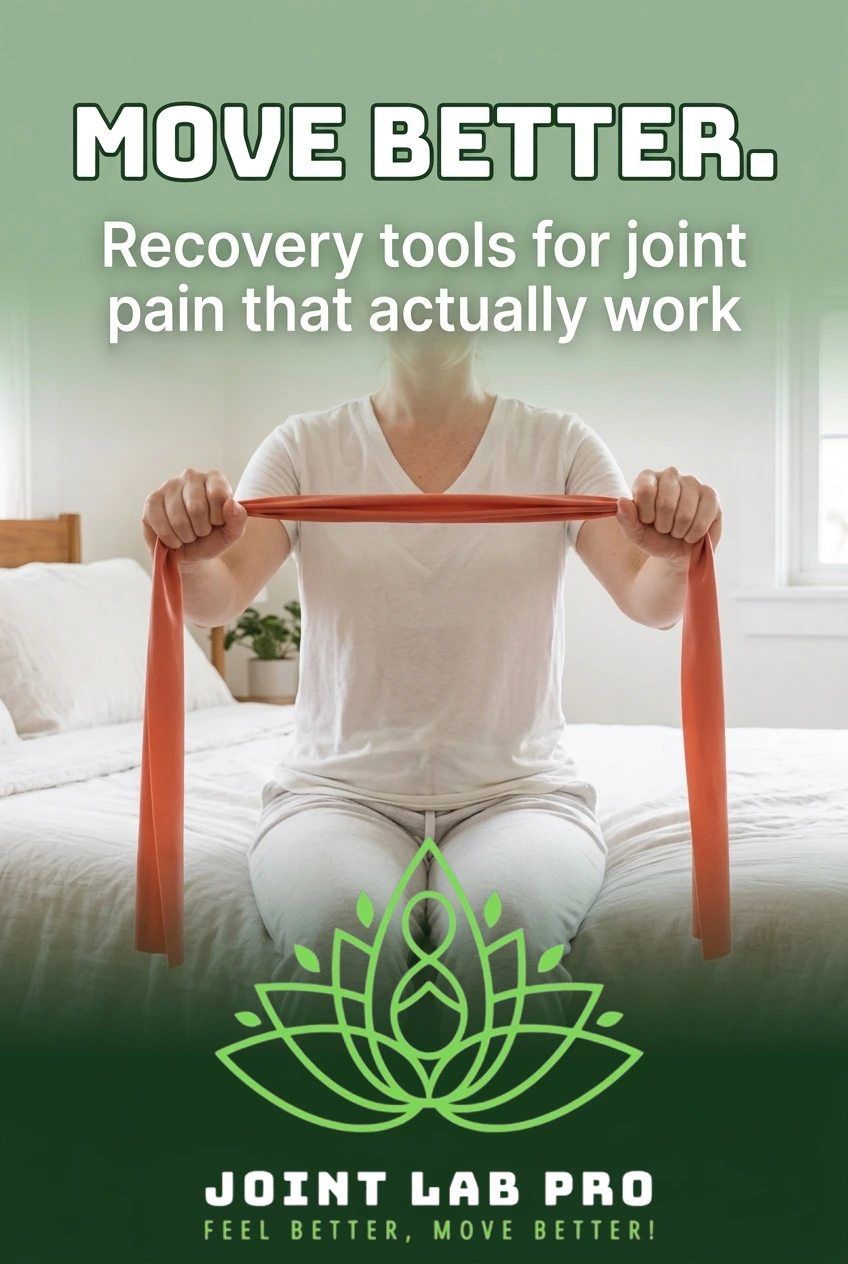
For joint pain specifically, resistance bands have a crucial advantage over free weights: the resistance increases gradually through the range of motion rather than being constant. This means the joint is never overloaded at its most vulnerable angle. Physical therapists have used TheraBand-style loop bands for decades precisely because of this.
⚠️ Critical Note for Joint Pain Users
Start with the yellow (extra light) band even if it feels easy. With joint pain, connective tissues and joint structures need time to adapt even when muscles feel strong enough for more. Increase resistance only after 2 weeks at each level with no post-exercise flare.
Best exercises for joint pain with these bands: clamshells (hip abductor strengthening), straight leg raises, seated knee extensions, glute bridges, and lateral band walks. All of these target the muscles that directly support the knee and hip without loading the joint with bodyweight.
📹 Getting started with resistance bands — official Fit Simplify guide
✅ Pros
- Under $10 for a full set of 5 levels
- #1 bestseller in resistance bands
- 134,993 Amazon reviews — extensively tested
- Instruction guide included — no guesswork
- Carry bag — easy to use anywhere, even seated
- Gradual resistance — joint-safe by design
✗ Cons
- Latex — not suitable if you have a latex allergy
- Can roll up on thighs during leg exercises
- No handles — some with hand arthritis find gripping difficult
- Light bands may not last as long with daily use
✅ Best For
- Anyone with OA following the ACR exercise guidelines
- Post-flare rehabilitation when returning to movement
- Beginners with no existing exercise equipment
- Seated or floor-based strengthening routines
- Budget-conscious buyers wanting maximum value
✗ Not Ideal For
- Latex allergies (choose TheraBand Non-Latex instead)
- Active RA flare — wait until inflammation settles
- Those needing handles for grip support
#2 Mid-Range Pick: TriggerPoint GRID 1.0 Foam Roller
🥇 Editor’s Top Pick — Most Recommended by Physiotherapists
TriggerPoint GRID 1.0 Foam Roller — 13″
Multi-density surface. EVA foam. Firm. 5.75 x 13 inches. 1-year manufacturer warranty.
| Price | Dimensions | Firmness |
|---|---|---|
| ~$39.99 | 5.75 x 5.75 x 13 inches | Firm (multi-density surface) |
| Rating | Material | Warranty |
| 4.7 / 5 stars | EVA foam | 1 year manufacturer |
The TriggerPoint GRID is the foam roller that physical therapists actually recommend most often — and there’s a reason for that. Its multi-density surface mimics the feel of a hand massage by alternating areas of varying firmness across the roller’s grid pattern. Where a basic foam roller applies uniform pressure, the GRID targets trigger points in the muscle tissue more effectively.
For joint pain, the critical thing to understand is what foam rolling actually does — and doesn’t do. A foam roller works on the muscles surrounding a joint, not on the joint itself. You should never roll directly over an inflamed or bony joint. What you’re doing is releasing tension in the quadriceps, hamstrings, IT band, and calves — all of which directly affect how much load and compression the knee joint experiences during movement.
💡 The Right Way to Use a Foam Roller with Joint Pain
Always roll the muscle, never the joint. For knees: roll the quads (front of thigh), hamstrings (back of thigh), and calves — but stop well above and below the knee cap itself. For hips: roll the glutes and outer hip. Spend 60-90 seconds per muscle group. Pause on tender spots until the sensation reduces by about 30% before moving on.
Best timing: Before activity (to prepare the muscles and improve blood flow) or after (to reduce post-exercise soreness). Avoid foam rolling during an active flare when joint tissue is already inflamed.
The 13-inch length of the GRID 1.0 is ideal for most people — long enough for full leg muscles but compact enough to use in a small space. The EVA construction means it holds its shape over years of use, unlike cheaper foam rollers that compress and lose effectiveness within months.
📹 TriggerPoint GRID 1.0 — official introduction and how to use
✅ Pros
- Most recommended by physiotherapists for joint conditions
- 4.7 stars across 23,500+ verified reviews
- Multi-density surface mimics hands-on massage
- EVA foam holds shape for years — worth the investment
- Compact 13-inch length — practical for home use
- Amazon’s Choice — consistently well stocked and priced
✗ Cons
- Firm texture — can feel intense for first-time users
- Getting to floor level is a challenge for some OA patients
- No vibration — for deeper release, consider vibrating models
- $40 is more than basic rollers — but worth it for longevity
✅ Best For
- OA patients managing quad and hip flexor tightness
- Anyone doing resistance band or light exercise — for pre/post rolling
- Those wanting a durable, physio-grade tool at a mid-range price
- People with IT band tension contributing to knee pain
✗ Not Ideal For
- Those who cannot get to floor level safely
- Active inflammatory flares (RA) — wait until settled
- Using directly on joints — only on surrounding muscle
#3 Premium Pick: TheraGun Relief by Therabody
🏆 Premium Pick — Built Specifically for Everyday Pain Relief
TheraGun Therabody Relief Handheld Percussion Massage Gun
FDA-registered. 10mm amplitude. Triangular ergonomic handle. App-guided routines for arthritis and chronic pain. 3 attachments.
| Price | Amplitude | FDA Status |
|---|---|---|
| ~$159.99 | 10mm (gentle — half of standard guns) | FDA-registered medical device |
| Rating | Handle | App |
| 4.6 / 5 stars | Triangular — easy grip with arthritis | Therabody app with arthritis routines |
Most massage guns are built for athletes recovering from intense workouts. The TheraGun Relief is the exception. Therabody designed it specifically for everyday pain relief in people who are not competitive athletes — which makes it the only massage gun I’d confidently recommend for joint pain sufferers.
The key difference is amplitude: 10mm versus the 16mm standard on athlete-oriented models. That 6mm reduction in depth means the Relief works on the superficial muscle tissue without the jarring percussion that can aggravate sensitive joint areas. It’s genuinely comfortable to use on tight quads and glutes in a way that deeper guns simply aren’t.
🔬 Why Amplitude Matters for Joint Pain
Amplitude is how far the head of the massage gun travels with each percussive stroke. Higher amplitude means deeper tissue penetration — appropriate for dense, healthy muscle tissue in athletes. For muscles surrounding arthritic joints, which are often in protective spasm and already sensitised, lower amplitude provides the circulation and tension relief benefits without the risk of over-stimulating already irritated tissue.
The triangular handle design is a genuinely clever ergonomic choice. Standard massage gun handles require awkward wrist angles to reach certain muscle groups — which matters considerably if you have hand, wrist, or shoulder arthritis alongside your primary joint condition. The triangular grip allows you to hold the device from multiple angles without straining your hand.
The Therabody app includes guided routines specifically designed for arthritis, sciatica, and general chronic pain. Each routine shows you exactly where to use the device, at what speed, and for how long — removing the guesswork that can lead to using it incorrectly.
📹 TheraGun Relief — official product tour by Therabody
✅ Pros
- FDA-registered — not just a fitness gadget
- 10mm amplitude — gentle enough for sensitised joints
- Triangular handle — arthritis-friendly grip
- App with arthritis-specific guided routines
- 4K+ purchases last month — real-world validation
- One-button control — simple to operate
- Quiet motor — usable without disrupting others
✗ Cons
- $159.99 — significant investment
- Lower amplitude limits deep tissue reach vs. athlete models
- Fewer speed settings than premium athlete models
- Not water resistant — can’t use post-shower
✅ Best For
- People with OA managing daily muscle tension
- Those who cannot easily get to floor level for foam rolling
- Anyone with hand or wrist issues needing an easy-grip device
- People who want guided, app-based instruction
- Those wanting an FDA-registered, clinically designed tool
✗ Not Ideal For
- Budget buyers — Fit Simplify bands offer better value at this life stage
- Active RA flares with significant swelling
- Use directly over bony joints — only on surrounding muscle
Side-by-Side Comparison
| Feature | Fit Simplify Bands | TriggerPoint GRID | TheraGun Relief |
|---|---|---|---|
| Price | ~$9.98 | ~$39.99 | ~$159.99 |
| Primary benefit | Strengthening | Muscle tension relief | Targeted muscle relief |
| Floor level required | Not always | Yes | No |
| Suitable for OA | Yes | Yes | Yes |
| FDA registered | No | No | Yes |
| Best timing | Anytime | Pre/post activity | Pre/post activity |
| Amazon rating | 4.5 ★ | 4.7 ★ | 4.6 ★ |
| Review count | 134,993 | 23,509 | 2,383 |
💡 Sarah’s Recommendation on Sequencing
If you’re choosing just one: start with the resistance bands. Strengthening the muscles around the joint has the greatest long-term impact on pain and function.
If budget allows, add the foam roller next. Use it before your resistance band exercises to warm up the muscles and improve range of motion.
The massage gun becomes valuable as a standalone tool when floor exercises aren’t possible — during high pain days, or for targeting specific areas of tension quickly without a full routine.
How to Use All Three Together: A Daily Recovery Routine
As a former PE teacher, the thing I stress most is sequence. The order in which you use these tools matters as much as the tools themselves.
🗓️ The 20-Minute Joint Recovery Routine
Step 1 — Foam rolling (5 minutes): Roll the major muscle groups around your most affected joints. Quads, hamstrings, glutes, calves. 60 seconds per area. This loosens the tissue and increases circulation before you ask those muscles to work.
Step 2 — Resistance bands (12 minutes): 3-4 exercises targeting the muscles that support your joints. Clamshells, glute bridges, straight leg raises. 2-3 sets of 12-15 reps. This is the strength work that changes your baseline pain level over time.
Step 3 — Massage gun (3 minutes): Target any areas that feel particularly tense after the exercises. 60 seconds per area. This helps flush out the muscular byproducts of exercise and reduces next-day soreness.
Best time to do this: Late morning — after morning stiffness has eased but before afternoon fatigue builds. This is when cortisol and joint fluid viscosity are at their most favourable.
You don’t need to do all three every day. The resistance bands are the priority — aim for 3-4 days per week. Foam rolling can be daily. The massage gun is most useful on high-tension days or when you can’t do a full routine but need some relief.
Combining Recovery Tools with Other Joint Pain Management
🔥 Recovery Tools + Heating Pad
15-20 minutes of moist heat on the joint before your recovery routine improves the effectiveness of both foam rolling and resistance band work. The heat loosens joint fluid and relaxes the surrounding muscles, making the subsequent exercises more comfortable and more effective. This combination is explicitly recommended in the ACR’s OA management guidelines.
💊 Recovery Tools + Joint Supplements
Glucosamine and chondroitin work on the cartilage level while recovery tools work on the muscular level. They’re complementary rather than redundant. If you’re taking collagen peptides, the amino acids they provide support the connective tissue you’re working and recovering in your routines.
⚠️ When Not to Use Recovery Tools
During an active inflammatory flare — when a joint is warm, swollen, and acutely painful — rest is more appropriate than recovery tool use. The foam roller and massage gun should only be used on muscles surrounding the joint, never directly on an inflamed joint. Resistance bands should be paused during severe flares and restarted at the lightest level once the flare settles.
Sarah’s Verdict
The Recovery Tools That Changed My Joint Pain Management
I spent years as a PE teacher telling students that recovery matters as much as the workout itself. Living with OA in both knees has made that more personal than I ever expected.
The resistance bands are the foundation. I use the yellow and red Fit Simplify bands three times a week for clamshells and glute bridges. The improvement in knee stability over six months of consistent work was more significant than anything else I’ve tried.
The TriggerPoint GRID is what I use before any activity — including just walking to the shops on a bad day. Five minutes on the quads and outer hip, and my knees function better for the next hour. The multi-density surface makes a real difference over basic foam rollers.
The TheraGun Relief earns its place on high-pain days when I can’t get to the floor for rolling. Standing, reaching my outer thigh or lower back — two minutes and the muscle tension releases in a way that changes how the joint feels immediately.
None of these replaces medication or medical management. But together, they’ve given me a physical toolkit for the days when I need to function despite pain — which, for most of us with OA or RA, is most days.
Frequently Asked Questions
Ready to Build Your Joint Recovery Toolkit?
Start with what fits your budget and your current pain level. The resistance bands are the highest-impact investment at any price point. Add the foam roller when you’re ready to upgrade. Save the massage gun for when floor exercises aren’t always possible.