
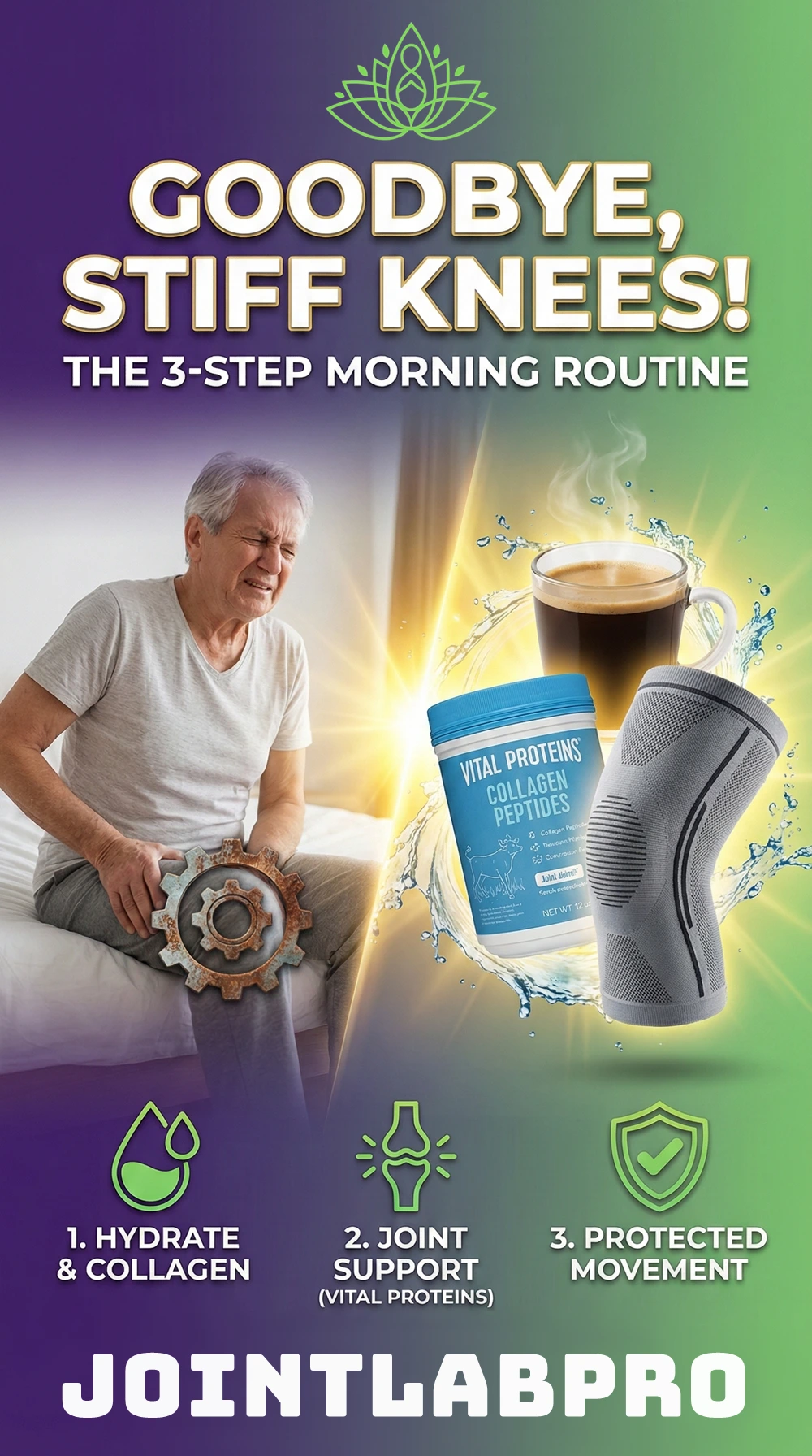
Morning Knee Stiffness, Why It Happens and the 3-Step Routine That Loosens It (2026)
That locked-up feeling in the first hour of the day has a name, the gel phenomenon, and it responds to a specific order of operations.
Morning knee stiffness is caused by synovial fluid thickening overnight, a process clinicians call the gel phenomenon. It eases within about 30 minutes in osteoarthritis and lasts over an hour in inflammatory arthritis. The routine that works starts with movement before you stand, then rehydration, collagen, turmeric, and warmth inside the first thirty minutes.
You know the feeling. The alarm goes off, you swing your legs out of bed, and the first few steps across the bedroom feel like your knees have forgotten how to bend. For a lot of us past forty, that first stretch of the day is the worst part of it.
Synovial fluid, the natural lubricant sitting inside the knee joint, thickens while you are still. After seven or eight hours of sleep it has become noticeably more viscous, so the first movements meet resistance. Natural synovial fluid production also declines with age, which is why the same night of sleep leaves a fifty year old stiffer than it leaves a twenty five year old.
I manage early osteoarthritis in both knees, so this is not theoretical for me. What follows is the order of operations that works, built up gradually over a couple of years rather than adopted overnight.
Key Takeaways
- Morning knee stiffness from osteoarthritis usually eases within 30 minutes of getting up and moving.
- Stiffness lasting more than an hour, and not improving with movement, points toward inflammatory arthritis and needs a rheumatologist.
- Synovial fluid thickens across 7 to 8 hours of inactivity, which is what makes the first steps of the day resistant.
- Natural synovial fluid production declines after age 40, so the same night of sleep produces more stiffness.
- Standardised 95% curcumin extract needs 3 to 8 weeks of daily use before stiffness improves, and ordinary turmeric powder contains only 2 to 5% curcuminoids.
- Moist heat applied for 15 to 20 minutes before movement thins synovial fluid, but should be skipped on a hot, red, or visibly swollen joint.
- Low-level red light therapy reduced knee OA pain versus placebo in a 2019 meta-analysis, though the evidence for easing stiffness specifically is weaker (Stausholm et al., BMJ Open; Fan et al., 2024).
First, How Long Does Your Stiffness Actually Last?
This is the question worth answering before you change anything, because the answer points in different directions.
Morning stiffness from osteoarthritis is usually short. It loosens within about thirty minutes of getting up and moving, and it tends to be worse after a day of heavy use. Morning stiffness from an inflammatory condition like rheumatoid arthritis behaves differently. It typically lasts longer than an hour, sometimes two, and it does not improve just because you are moving around.
If you are consistently spending an hour or more waiting for your joints to loosen, and especially if the same stiffness shows up in your hands, wrists, or both sides of your body symmetrically, that pattern is worth taking to a rheumatologist rather than a supplement aisle. Nothing on this page substitutes for that.
The distinction that matters
Short stiffness that improves with movement points toward a mechanical and lubrication problem. Prolonged stiffness that persists despite movement points toward active inflammation. The routine below helps with the first and can support the second, but it does not replace treatment for the second.
Rehydrate, Then Give the Cartilage Something to Work With
You wake up mildly dehydrated. Synovial fluid is mostly water, so rehydrating first thing is the cheapest thing you can do for the viscosity problem, and it costs nothing. Drink a glass of water before the coffee, not after.
Water alone does not rebuild anything, though. Hydrolyzed collagen peptides are the amino acid building blocks the body draws on to maintain cartilage, tendon, and the tissue lining the joint. Research suggests orally taken collagen peptides accumulate in cartilage and prompt the cells there to increase their own collagen production. That works on the underlying tissue rather than on the sensation, which means it is slow. You are not going to feel it in a week.
One detail gets skipped often enough to be worth naming. Vitamin C is the co-factor for the enzyme that stabilises collagen’s triple helix structure. Without it, the collagen your body builds is structurally weaker. Plenty of collagen powders leave it out entirely, so check the label.
What I use: Vital Proteins Collagen Advanced, mostly because it dissolves completely in hot coffee and includes both vitamin C and hyaluronic acid in the same scoop. Hyaluronic acid supports synovial fluid quality directly, which is the exact problem we are talking about. Read the full review or check today’s price on Amazon.
The reason this goes in the coffee rather than in a separate glass is practical. A supplement you have to remember is a supplement you will skip. One that lands in a drink you were making anyway is one you will still be taking in six months.
Bring Down the Background Inflammation
Underneath the mechanical stiffness there is usually a low level of inflammation producing the dull ache that lingers past the first few steps. Ibuprofen handles that acutely, but daily long term use carries gastrointestinal and cardiovascular risk, which is why most doctors will steer you away from making it a habit.
Curcumin, the active compound in turmeric, inhibits several inflammatory pathways that are upregulated in arthritic joint tissue, including COX-2 and NF-kB. Randomised trials of standardised 95% curcumin extract have found pain and stiffness scores in knee osteoarthritis comparable to some NSAIDs over an eight to twelve week course, with fewer side effects across daily use.
Bioavailability is where most turmeric products fall apart. Ordinary turmeric powder from the spice rack contains only two to five percent curcuminoids and absorbs poorly. A 95% standardised extract paired with black pepper extract absorbs dramatically better. If the label does not mention piperine or BioPerine, you are probably paying for something your gut will not absorb.
Give it three to eight weeks. Turmeric does not have an acute effect you can feel on day two, which is precisely why so many people try it for a fortnight, notice nothing, and conclude it does not work.
Two that fit: BioSchwartz Turmeric uses the same 95% standardised extract and BioPerine combination the trials used. Qunol Turmeric delivers a higher curcuminoid dose per serving at a similar price if you want more. Read the BioSchwartz review or check today’s price on Amazon.
Take it with food that contains some fat. Curcumin is fat soluble, and taking it on an empty stomach wastes part of the dose.
Motion Is What Actually Circulates the Fluid
Here is the part no supplement replaces. Synovial fluid thins and circulates when the joint moves. Nothing you swallow does that job. The trouble is that a stiff knee makes those first steps unpleasant, so people sit down, and sitting down makes the next attempt worse. That loop is how morning stiffness turns into all-day stiffness over the course of a few years.
Start before you are upright. Ankle circles and gentle heel slides while still in bed get blood moving through the joint before it has to carry your weight. Then get vertical and walk, even if it is only around the kitchen.
A light compression sleeve for the first half hour helps more than it sounds like it should. Compression improves proprioception, which is the joint’s sense of where it is in space, and it holds warmth in. Warmth is doing the real work: warm synovial fluid is less viscous than cold synovial fluid.
| Support Type | Best For | Why It Helps in the Morning |
|---|---|---|
| Compression sleeve | Mild stiffness, daily activity, walking | Holds warmth in and improves the joint’s positional feedback |
| Structured brace | Instability, buckling, knees that give way on stairs | Adds lateral stability that a sleeve cannot provide |
| Moist heat | Very stiff mornings, inflammatory flares | Penetrates the joint capsule and thins the fluid before you move |
What I reach for: a Modvel compression sleeve for the first hour of the day. It stays put while walking and comes as a two pack, so one is always clean. Read the review or check today’s price on Amazon. For a fuller comparison, see the knee brace comparison.
On the worst mornings, heat before you move. If the stiffness is severe, fifteen to twenty minutes of moist heat on the knee before you try to walk changes the entire morning. Moist heat reaches the joint capsule better than dry heat does, and it loosens the thickened fluid faster than movement alone will. I use the GENIANI pad for this since it wraps around the knee and has a moist heat setting, or check today’s price on Amazon. Skip the heat if the joint is hot, red, or visibly swollen, since that is a flare and heat will make it angrier.
Where Red Light Therapy Fits
I saved this one for last because it is the piece of my morning that took the longest to add, and the one I went in most skeptical about.
Red light therapy uses two wavelengths that do different jobs. The red light around 660nm works near the surface, on skin and the tissue just beneath it. The near-infrared around 850nm travels deeper, a couple of centimetres in, far enough to reach the muscle and the knee joint itself. Both are thought to work by nudging the mitochondria in those cells to produce energy more efficiently, which is the proposed mechanism behind the drop in pain people report.
Here is the honest version of the evidence, because it is more mixed than the marketing suggests. A 2019 meta-analysis of placebo-controlled trials found low-level light therapy lowered pain in knee osteoarthritis compared with a sham device (Stausholm et al., BMJ Open). A 2024 network meta-analysis of 13 trials backed up the pain benefit but did not find a clear effect on stiffness or function specifically (Fan et al., Aging Clinical and Experimental Research). So the case for pain is reasonable, the case for stiffness on its own is thinner, and most of those studies used clinic-grade devices stronger than any home belt. I treat mine as a gentle add-on, not the main event.
For a stiff morning knee, I wrap a red light belt around the joint for about ten minutes while the coffee brews and the collagen dissolves. It doubles as warmth, which helps on its own, but the point is the 850nm light reaching the joint. Like the turmeric, there is no day-two moment here. Give it a few weeks of near-daily use before you decide either way.
What I use: a Hooga red light therapy belt with both 660nm and 850nm wavelengths, wrapped around the knee most mornings. Read the belt comparison or check today’s price on Amazon.
The Thirty Minute Version
| When | What | Why |
|---|---|---|
| Still in bed | Ankle circles, heel slides, fist clenches | Blood flow before weight bearing |
| First thing up | Glass of water, then collagen in the coffee | Rehydration plus tissue building blocks |
| With breakfast | Turmeric with food containing fat | Builds an anti-inflammatory baseline over weeks |
| Optional add-on | Red light belt on the knee, about 10 minutes | 850nm reaches the joint, and it doubles as warmth |
| Before walking | Compression sleeve on | Warmth and proprioceptive feedback |
| Bad mornings only | Moist heat, 15 to 20 minutes | Thins the fluid before you ask the joint to work |
What Has Not Helped, in My Experience
Worth saying, because plenty of guides only tell you what to buy.
Stretching a cold, stiff knee does very little and occasionally makes it feel worse. Heat first, then stretch. Glucosamine and chondroitin did nothing noticeable for me, which lines up with a research picture that is genuinely mixed rather than damning. Cheap turmeric without piperine is money set on fire. And there is no supplement in the world that outperforms simply getting up and walking, which is the least marketable advice on this page and also the truest.
Where to start if you only change one thing
Add the water and the in-bed ankle circles. They cost nothing, they work on the mechanism directly, and they take four minutes. Everything else on this page builds on top of movement, not instead of it.
Frequently Asked Questions
Why are my knees stiff in the morning?
Morning knee stiffness is caused by the gel phenomenon. Synovial fluid, the lubricant inside the knee joint, thickens during periods of inactivity such as sleep. After seven or eight hours it becomes more viscous, so the first movements of the day meet resistance. Natural synovial fluid production also declines after age 40, making the effect more pronounced.
How long should morning knee stiffness last?
Stiffness from osteoarthritis usually loosens within about 30 minutes of getting up and moving. Stiffness lasting longer than an hour, and not improving with movement, is more typical of inflammatory arthritis such as rheumatoid arthritis and should be assessed by a rheumatologist.
Does collagen help with morning knee stiffness?
Hydrolyzed collagen peptides supply the amino acid building blocks used to maintain cartilage and joint tissue. Research suggests oral collagen peptides accumulate in cartilage and stimulate collagen production there. The effect is gradual rather than acute, so it works on the underlying tissue over months rather than relieving stiffness on a given morning. Vitamin C is required as a co-factor for collagen synthesis.
Should I use heat or ice for morning knee stiffness?
Heat is appropriate for morning stiffness, since warmth reduces the viscosity of synovial fluid and loosens the joint before movement. Moist heat penetrates the joint capsule better than dry heat. Heat should be avoided if the joint is hot, red, or visibly swollen, which indicates an active inflammatory flare.
How long does turmeric take to work for joint stiffness?
Standardised 95% curcumin extract typically requires three to eight weeks of consistent daily use before a meaningful reduction in joint stiffness is noticed. Curcumin absorbs poorly on its own, so a product paired with black pepper extract, listed as piperine or BioPerine, is substantially more bioavailable. Taking it with a meal containing fat also improves absorption.
Does red light therapy help morning knee stiffness?
Red light therapy has stronger evidence for reducing knee osteoarthritis pain than for stiffness specifically. A 2019 meta-analysis of placebo-controlled trials found low-level light therapy lowered knee OA pain versus a sham device (Stausholm et al., BMJ Open), while a 2024 network meta-analysis confirmed the pain benefit but not a clear effect on stiffness or function. The near-infrared 850nm wavelength penetrates deep enough to reach the knee joint. Home belts are lower-powered than clinic devices, so it works best as a gentle daily adjunct alongside movement and heat, not a replacement.
Keep Reading on JointLabPro
- Knee pain exercises, the five movements that build support around a stiff joint once you are past the morning hour.
- Best joint supplements 2026, a fuller look at what the research supports and what it does not.
- Nighttime joint pain and sleep, because how you sleep decides how stiff you wake up.
- Best pillow for neck and joint pain, if the stiffness reaches your neck and shoulders too.
- Red light therapy belts for joint pain, what I use on my knees most mornings alongside the routine above.
- Joint support, the complete guide, everything in one place.